 Tildown
Beautiful neighbourhoods: location, parks and clean air
Two houses of the same size don’t pay the same tax, and a district in smog stops growing. Here is how location, parks, beauty and smog fit together in the game – and how to build districts that pay off.
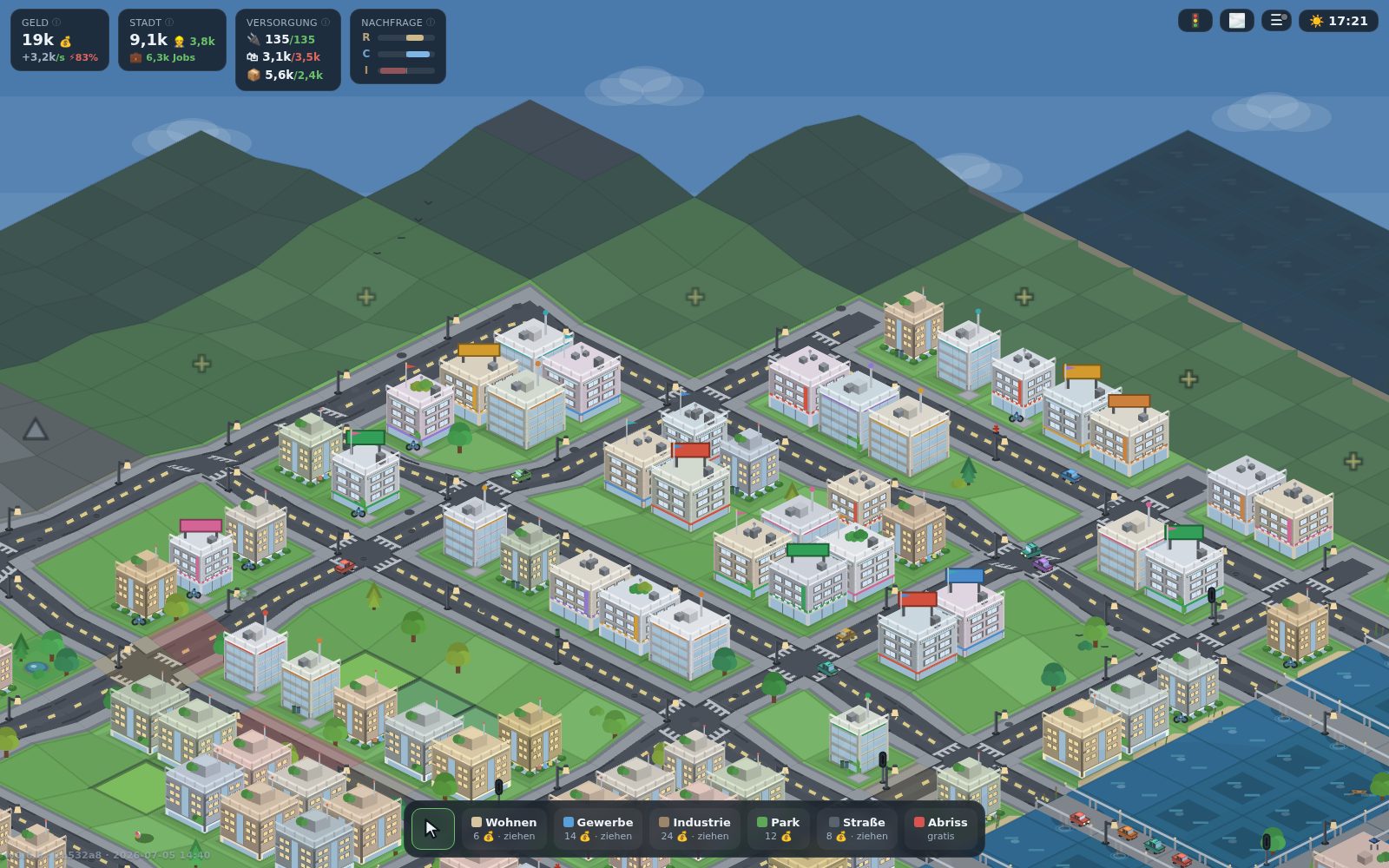
How the location bonus works
Every home, shop and factory gets a location bonus of up to +25% on its taxes – a pure bonus that raises only taxes, not upkeep. Every percentage point goes straight into your surplus (more in the money tips).
It is short-sighted: only what lies at most two tiles away counts, measured along the tiles – so a tile diagonally across the corner is already two steps away. Direct neighbours count fully, the second ring half, roads never.
What residential, commercial and industry like
- 🏠 Residential: parks and water. A home right on a straight shore gets 20 to 25% from the water view alone, one row back only 5%.
- 🏢 Commercial: foot traffic. Homes count a little more than other shops, factories not at all. A shop between houses reaches the full 25% – and takes nothing away from the houses.
- 🏭 Industry: other factories. In the middle of an industrial area a factory quickly hits the cap.
- 🌳 Parks help all three, but only half as much for commercial and industry as for residential.
You see the bonus when you tap a building in cursor mode: in the building panel under “📍 Location”. With a mouse you can see it even earlier: move a zone tool over free land next to a road, and a small 📍 label shows the bonus a building would get there. Only near water (residential) and in the mountains (commercial) does it show the villa or hotel spot instead.
Parks: spread them out, don’t clump them
A park costs 18 💰 per tile, needs neither a road nor upkeep, and you get half back when you demolish it. It may even go on a slope where no building can stand – ideal for embankments in the middle of town.
It works at three distances: two tiles for the location bonus, four tiles for the air and five tiles for beauty – each time strongest right next to it.
For location, that means single park tiles between the houses do far more than one big park at the edge: a single tile reaches up to twelve tiles around it, nine tiles in a block reach only 28 together – spread out, up to 108. And once a home shows the full 25%, another park adds no bonus to it.
Beauty: villas, mountain hotels and tall towers
Beauty shows in the 🌸 beauty view under 🗺️, from “nice” through “lovely” to “dream spot”. It is not bound by the 25% cap on location: depending on beauty, a villa pays roughly four to six and a half times what an ordinary house of the same level pays, and a mountain hotel triples its taxes at full beauty – so plant parks on the slopes around it. How both come about is explained in the guide.
Water makes a place beautiful by itself: up to the third row back from the shore that alone is enough for villas if the air is clean; in the fourth row you also need a park. Tiles with a thin outline in the beauty view are beautiful enough for villas by the water – and for residential towers that are meant to grow past level 30.
Villas are sensitive: even a whiff of smog that the smog view doesn’t colour yet stops their growth, and just above the threshold they grow at only a quarter of the pace of a dream spot.
Smog: where it comes from and how to read it
Smog comes only from industry, and it grows along with it: a factory at level 10 smokes ten times as much as at level 1. It drifts up to four tiles and thins out as it goes; five tiles away nothing arrives from an ordinary factory, from a mine only from nine tiles on.
In the smog view under 🗺️, yellow means light, orange noticeable and violet heavy. The stronger the colour, the lower the ceiling a home can grow to: in orange it loses about three levels, in violet six or more. If it already stands higher, residents move away; if it sits at its ceiling in orange, it pays no tax at all – the building panel then says “🌫️ air too dirty for this height”.
Commercial and industry, on the other hand, grow and pay as usual in smog. Only homes suffer – and mountain hotels, because smog lowers their beauty.
Where industry belongs
Industry likes company, because its bonus comes from other factories. A compact industrial area pays off twice: full location for the factories, and the smog stays in one place.
Keep at least five tiles between industry and housing – ideally filled with commercial: shops don’t mind the smoke, and they get foot traffic from the houses next door. Don’t make the gap bigger than needed, though, because long commutes slow growth (tips against traffic jams). Homes already stuck in smog can be rezoned to commercial in the building panel; they then start again at level 1.
A park in between helps, but it is not a wall – it is an air purifier: it lowers the smog around it, no matter which direction it comes from. Put it right next to the coloured houses. Against a big factory right next door, though, even several parks are not enough.
In the mountains you have to choose: the same high ground turns commercial into hotels and industry into mines – and a mine smokes out eight tiles around it, including the beauty the hotels live on. So hotels on one mountain, mines on another.
Landmarks: beauty for a whole district
First, a landmark raises the location bonus of every building around it: by about 21% right next to it, and by just under 4% six tiles away. Diagonal counts the same as straight here, so the area is a square. Where parks or water already fill the bonus, it adds nothing because of the cap.
Second, it raises beauty, which is not bound by that cap: up to three tiles away the landmark alone makes it beautiful enough for villas by the water. So place it where things aren’t pretty yet – in a district without greenery, or by the shore, where every villa pays more the more beautiful it is. Demolishing refunds nothing; when the tool unlocks is in the guide.
Try it right away – free in your browser, no download.
▶ Play now