 Tildown
Avoiding traffic jams: road networks that flow
In Tildown, a traffic jam never takes money away and never downgrades anything – but it slows your homes down and, at worst, keeps them stuck at their level. A home that does not grow will not pay higher taxes either. Once you know how commuters drive, you can usually fix it with a few well-placed tiles instead of an expensive megaproject.
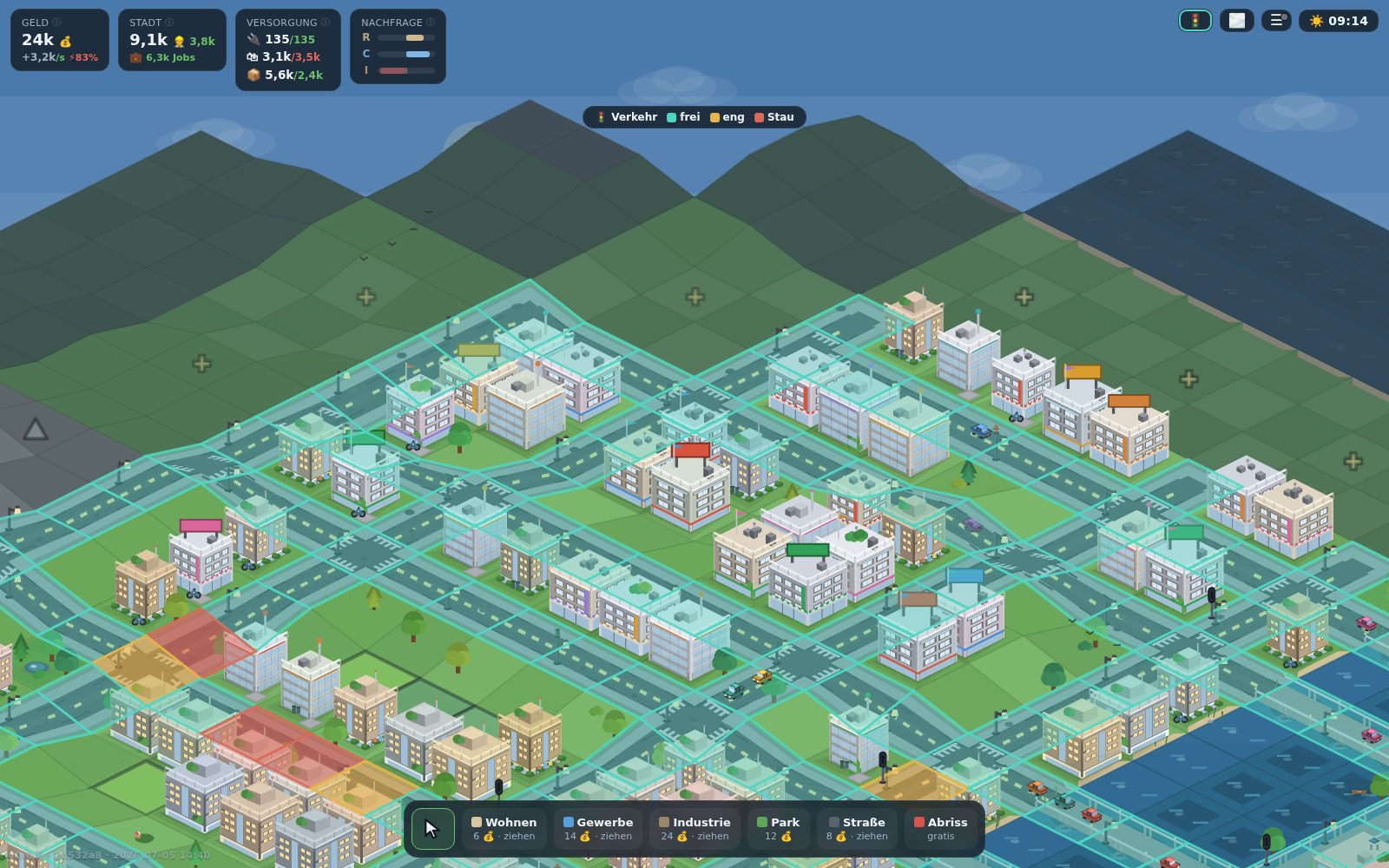
How traffic works in Tildown
Every connected home sends its workers off to work – a little over four in ten residents. They take the shortest route to the nearest commercial or industrial building in the same road network, and every road tile along the way counts how many commuters roll across it.
One tile of ordinary road carries 400 commuters, a main road 2.5 times as many. Tap a road in cursor mode and the game tells you the trips per day and the load in percent – 400 commuters show up there as about 800 trips, because everyone drives there and back.
The most important point for everything that follows: commuters pick their route by length, not by traffic. If the shortest road is full, they stay on it anyway. A detour that is even slightly longer for them gets none of them.
Reading the traffic view
You open the traffic view with the 🗺️ button at the top right, then 🚦 Traffic. Teal means free, amber busy – from 70% load – and red a jam from 100%. An outline of its own marks a separate network: its homes cannot reach the jobs in the rest of your city.
For a home, only the most loaded tile on its route matters. Below 85%, traffic does not slow it at all; above that it grows more slowly, and at 100% its level freezes. A jam never downgrades anything, and commerce and industry have no jam brake at all. The tasks that ask for jam-free households draw the line at 85% too.
To see exactly where it sticks, tap a home: the game draws its residents’ commute in the same colours, and the building panel names the reason, such as “waiting for clear roads” or “growing slowly – traffic congestion”. The basics are in the traffic chapter of the guide.
Typical mistakes that cause jams
- One single access road for a whole district: every commuter behind it has to pass that one tile. A level-10 home sends out 17 commuters – about two dozen such homes already fill an ordinary road.
- The dormitory town on the edge: homes here, all the jobs far away over there. That makes routes long and bundles all the traffic onto a few roads.
- The relief road that loops around: a parallel road that is longer than the full axis stays empty.
- Blaming the traffic lights: lights appear by themselves at intersections with a lot of commuter traffic. They show you where it is busy, but they cost no capacity.
The tricky part of a single access: the jam usually does not sit inside the district, but where all the routes come together – often on the last tiles before the first shops or factories.
Cheap first: proximity, grid, main road
Proximity costs nothing, because zoning is free. Spread commerce in small pieces between your residential districts instead of gathering all the jobs in one place – every home drives to the nearest workplace, and short routes load few tiles. Keep industry at a little distance because of the smog; commerce does not pollute. Up to 10 tiles, the commute costs you nothing; beyond that, the home’s taxes and growth drop until they reach only 55% at 40 tiles. Beyond level 20, into a city tower, a home only grows at all if its commute is at most 10 tiles. How to keep the three sectors in balance at the same time is covered in our tips on balancing the sectors.
A second road costs 8 💰 per tile. Give large districts several access roads, and build a grid rather than a single through road. If a home sits between two equally short roads, it splits its commuters between both – so a parallel road right along the row of homes relieves the full axis immediately.
Main roads unlock at chapter 5 or 3,500 residents: use the main-road tool, or drag the road tool a second time over an existing road. A main road carries 2.5 times as much and counts only half towards the commute. Its price per tile grows with your land and the number of your connected buildings, though; the toolbar shows what a tile costs today. So don’t upgrade the whole axis – upgrade the red tiles where the routes bundle. A short stretch is often enough.
One side effect: because a main road counts only half, more shortest routes often run over it after the upgrade. It pulls traffic away from the side streets – keep an eye on the roads leading to it afterwards.
Motorway: for the long distances
The motorway joins at chapter 8 or 15,000 residents. Its big advantage: distance on the carriageway does not count towards the commute at all, so in the game’s arithmetic a distant residential district moves close to your jobs. One tile carries 3,000 commuters per carriageway – 7.5 times an ordinary road.
It is not cheap: 20,000 💰 per tile and carriageway, so 40,000 💰 per tile of route, plus 120,000 💰 for each junction, which is always built as a pair. It does not serve buildings – it links districts, it does not open them up.
Congestion rarely forms on the route itself, but at the junctions: per carriageway they carry only as much as a main road, and they need a main road right next to them. So plan several junctions rather than a single one. And don’t run the route right past your nicest residential areas – its noise lowers the beauty there.
Railway: it pays off over distance
From chapter 9 or 20,000 residents you can build tracks and stations. You don’t plan lines: your commuters switch by themselves wherever the rail genuinely shortens their route. The ride on the track does not count towards the commute, but every change between road and rail counts like one tile of distance. On short routes that hardly helps; over long stretches it saves a lot of tiles.
Put stations in the middle of your districts, not on the edge: commuters walk the last six tiles of road before a station and put no load on them. Anyone who lives further away drives the stretch before that – then the approach to the station may be what is jammed, and the building panel says “waiting for clear roads to the station”.
Count on the price: from 40,000 💰 per track tile and 400,000 💰 per station, and two stations are the minimum. There is more in the railway chapter of the guide – and for raising the money for projects like this, see our money tips.
Try it right away – free in your browser, no download.
▶ Play now