 Tildown
The right start: your first hour in Tildown
Every new city starts with 150 💰 and a single parcel of 3×3 tiles. What you get right in the first minutes carries you a long way – here is an opening plan from your first road to the moment you close the game.
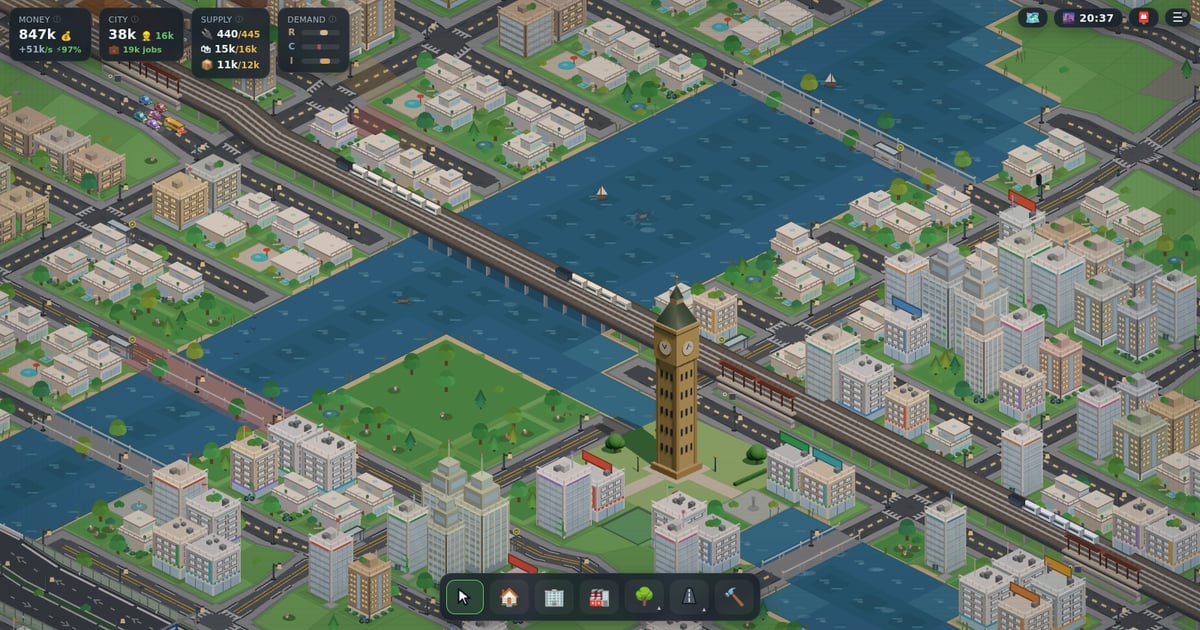
The first minutes: one road through the middle
As a new player, the “First steps” course guides you through five steps: road, residential, commercial or industry, your first extra parcel, a park. Just follow it – along the way you already complete your first task.
Draw your first road as a straight line through the middle row of your starting parcel: three tiles become road, and all six others sit right next to it. The very first road tile is free, each one after that costs 8 💰 – 16 💰 in total.
Roads cost no upkeep; their real price is space, because nothing grows on a road tile. When you buy the next parcel in line with the road, simply continue it straight on – every tile sits on the road again, everything stays one shared network, and after four parcels you have exactly the 12 road tiles chapter 1 asks for.
The right zones first
Zoning costs nothing, and buildings appear by themselves according to demand – but only on tiles that touch a road along an edge. A corner is not enough, and a zone two tiles back waits until a road runs right beside it.
Your starting parcel fits 🏠 Residential on one side of the road and 🏢 Commercial on the other. Commerce brings jobs and shops and makes no smoke. Housing alone would be a false start: anyone without work draws welfare, and that comes out of your taxes.
What to build next is shown on the “Demand” card: a bar to the right means “build more of it”, a bar to the left in red means “too much”. Behind it is a simple chain: residential needs jobs and shops, commercial needs customers and goods, industry needs workers. More in the tip on keeping the sectors in balance.
Industry: yes – but not on the doorstep
Shops need goods, and goods only come from factories. But industry smokes: the fumes of an ordinary factory reach four tiles and get thicker with every level. In a parcel of 3×3 tiles no two tiles are more than four steps apart – so a factory there spares no house at all.
You only notice once the factory has grown: smog lowers the height homes may grow to, residents move out, and a home stuck at that limit in thick air pays no tax at all – yet it still costs upkeep. So put your first factories at the far end of a parcel you have bought, at least five steps (counted along the edges) from the nearest home. No smoke reaches that far.
The smog view in the 🗺️ menu shows how clean the air is. Parks clean it, but distance remains the best protection – more in the tip on pleasant, livable neighbourhoods.
Tasks: the fastest money early on
The 🎯 Tasks already count while the course is running. They come in sets of three: the next three only appear once all three are done – if one stalls, go after it directly. Each pays gold straight away: its base amount plus 20 seconds of your net income, but never more than twice the base amount. Saving tasks up hardly pays.
Early on, that is a lot of money. “Connect your first building to the road network” alone pays at least 240 💰, more than your starting money; the seven tasks of chapter 1 “Founding” together pay at least 2,850 💰. On top of that, every completed set of three adds a permanent +3 % profit, as the guide explains.
Land: when and where to buy
You buy land with the cursor tool (↖): click or tap a parcel with a + marker. Only a parcel that shares a whole side with your land can be bought. The price depends solely on how many parcels you already own: the second costs 120 💰, the following ones 330 💰, 597 💰, 908 💰 and 1,258 💰. “Develop 6 land parcels” from chapter 2 counts your starting parcel – that is five purchases, 3,213 💰 in total.
So choose the spot by its terrain. A plain + means all nine tiles are buildable. With “+ 6/9” only six are flat and dry, and zones only go there – a mostly sloping parcel still counts in full towards the price. A river, on the other hand, is valuable: chapter 2 asks you to “Cross a river with a bridge” (180 💰 per bridge tile), and villas appear along the banks later on.
Buy as soon as you have a plan for the land – it earns nothing until it has a road and zones, and you cannot sell it back. More on handling money in the tip More money for your city.
Typical beginner mistakes
- Zones away from the road – nothing appears there.
- Roads that only touch at a corner – they are not connected.
- Only housing, no jobs – the unemployed keep costing welfare.
- The factory next to the homes – smog caps them.
And take care when demolishing: the Demolish tool is free, but it refunds nothing – money spent on a road is gone, only parks give half back, 9 💰 per tile. A demolished house starts again at level 1 as a new building, and “Rezone” in the building panel also costs money and resets it to level 1. Only zones with nothing on them yet are free to change: placing and removing them costs nothing.
When you close the game
Your city does not grow without you, but the coffers keep ticking: if you were away for at least ten minutes, your net income for that time is credited when you return – rounded down in five-minute steps and for one hour at most. The same applies if the game was only in the background; the “💤 Welcome back!” message tells you the amount.
Stop while your city is in good shape: what you are credited is the net after upkeep and welfare, so unemployed residents and homes in smog cost you during the break too. A zone you place just before leaving will not build up until you return. And more than one hour never counts.
Try it right away – free in your browser, no download.
▶ Play now